
Business Email Compromise in BFSI and Pharma: A Layered Defence Playbook
8 July 2026 · 3 min read · Cloud Armor Security Team
- Email Security
- BEC
- BFSI
- Pharma
- Barracuda
TL;DR — Business Email Compromise (BEC) is a fraud, not a malware attack: a convincing message impersonating someone your finance team trusts. Because there is no payload, signature-based filtering never sees it. Breaking BEC takes four layers working together — domain authentication (DMARC), AI-based impersonation detection, payment-change verification process, and user reporting wired to a SOC.
Why BFSI and pharma are BEC's favourite targets
BEC follows money and urgency. Banks, insurers and NBFCs move large sums on routine instructions; pharma companies run global supplier networks with invoices crossing borders and time zones. Both sectors share the attacker's ideal conditions: high transaction values, distributed teams who rarely meet, and payment processes that run on email.
The mechanics are simple and brutal:
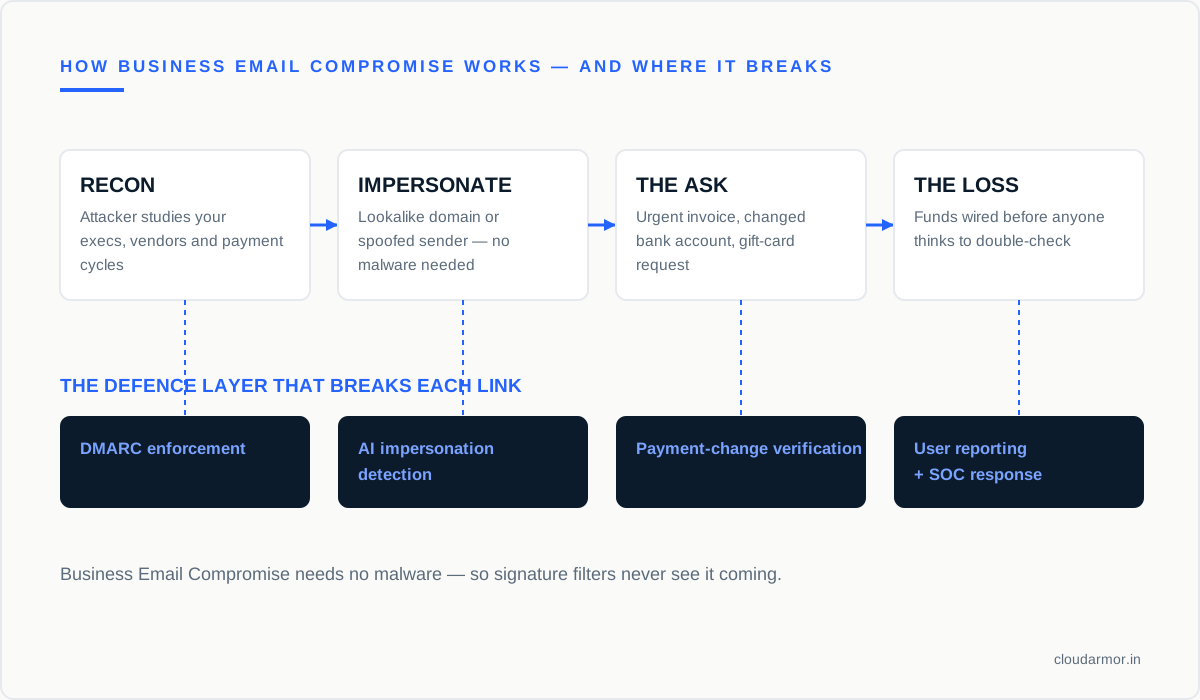
No malware. No exploit. Nothing for a traditional filter to detect — which is why BEC's direct global losses exceed ransomware's, year after year, in FBI IC3 reporting.
The four layers that break the chain
1. Domain authentication — make your own domain unspoofable
SPF, DKIM and DMARC at enforcement (p=quarantine/p=reject) mean
attackers cannot send mail as your domain to your customers, partners
and banks. Most organisations stall at monitor-only DMARC forever;
getting safely to enforcement is a project we run as standard — see the
email security practice.
2. AI impersonation detection — catch the lookalike
When attackers can't spoof you, they imitate you: lookalike domains, display-name tricks, compromised supplier threads. Detecting this requires analysing sender behaviour, relationships and message intent — the layer tools like Barracuda Advanced Email Protection provide. We deployed exactly this at India's Insurance Information Bureau, SIRA Consulting and Avance Consulting.
3. Payment-change verification — the process control
Technology narrows the funnel; process closes it. One rule, enforced without exception: any change to payment details is verified through a second channel (a known phone number — never the contact details in the email itself). This single control defeats the endgame of nearly every BEC campaign.
4. Report-and-respond — assume one gets through
One-click user reporting, feeding a SOC that can purge a campaign from every mailbox post-delivery. This is where email security stops being a product and becomes an operation — the role Ayati One plays for our managed clients.
Pharma's special case: the supplier web
Pharma BEC rarely impersonates the CEO — it impersonates the supplier: a contract manufacturer's "updated bank details", a logistics partner's "revised invoice". Defence therefore extends beyond your own mailboxes: DMARC protects your domain against use in attacks on your partners, and supplier-onboarding must register payment-verification contacts up front.
Frequently asked questions
We have Microsoft 365 filtering — isn't that enough?
Native filtering catches commodity phish. Targeted impersonation with no payload is specifically engineered to pass it. Layering a behaviour-analysis engine over the platform is the standard remedy — it's the architecture we deploy with Barracuda.
What's the single fastest win against BEC?
The payment-change verification rule. It costs nothing, deploys in a policy memo, and breaks the attack's final step. Do it this week; build the technology layers behind it.
How do we know if our domain is already being spoofed?
DMARC reporting shows every source sending as your domain — legitimate and malicious. It is monitor-mode, zero-risk, and usually eye-opening. Ask us for a DMARC posture check.
Move money or medicines on email instructions? Talk to Cloud Armor about layered email security for BFSI and pharma — Barracuda, Microsoft Defender for Office 365, Check Point and Sophos, deployed across India, UAE and the US.
Blog timeline
Explore the full series
27 July 2026 · 4 min read
Wazuh vs Commercial SIEM: The Real Enterprise Trade-off
27 July 2026 · 3 min read
Managed SOC & SIEM With Data Residency in India
26 July 2026 · 3 min read
Choosing an MSSP in Hyderabad, Dubai & the GCC
26 July 2026 · 8 min read
IBM QRadar Alternatives: Ayati One as a Managed SIEM + AI-SOC
25 July 2026 · 3 min read
An Arctic Wolf Alternative for India: Pricing & Residency
24 July 2026 · 2 min read
A Rapid7 InsightIDR Alternative: Managed, In-Region SIEM
23 July 2026 · 3 min read
A Microsoft Sentinel Cost Alternative: Beyond Per-GB Pricing
22 July 2026 · 3 min read
IBM QRadar Migration: A Practical Path Off QRadar
21 July 2026 · 3 min read
RBI Cybersecurity Framework: SOC Monitoring & 6-Hour Reporting
20 July 2026 · 3 min read
SEBI CSCRF Compliance: SIEM, SOC & the M-SOC Option
19 July 2026 · 3 min read
UAE NESA/SIA & Dubai ISR: Security Monitoring for Compliance
18 July 2026 · 3 min read
IRDAI 2023 Cyber Security Guidelines: SOC, VAPT & Reporting
18 July 2026 · 3 min read
The Enterprise DLP Implementation Checklist: What Most Rollouts Miss
17 July 2026 · 3 min read
DPDP Act & Rules 2025: Breach Detection & 72-Hour Notification
15 July 2026 · 4 min read
Data Loss Prevention for BFSI in India: The RBI, IRDAI and DPDP Act Compliance Guide
12 July 2026 · 3 min read
Forcepoint vs Safetica: How to Choose Between Enterprise DLP and Cloud-Native SaaS DLP
10 July 2026 · 3 min read
IAM vs SSO: What's the Difference, and What Does Your Enterprise Actually Need?
8 July 2026 · Currently reading
Business Email Compromise in BFSI and Pharma: A Layered Defence Playbook
5 July 2026 · 3 min read
Pharma Cybersecurity: Protecting Drug IP, Clinical Trial Data and GxP Systems
Put this into practice.
Our engineers deliver what these guides describe — from assessment to a running control. Bring us your environment.