
Vulnerability Assessment & Penetration Testing (VAPT)
Find the paths an attacker would take — before an attacker does — and fix what actually matters.
What it is
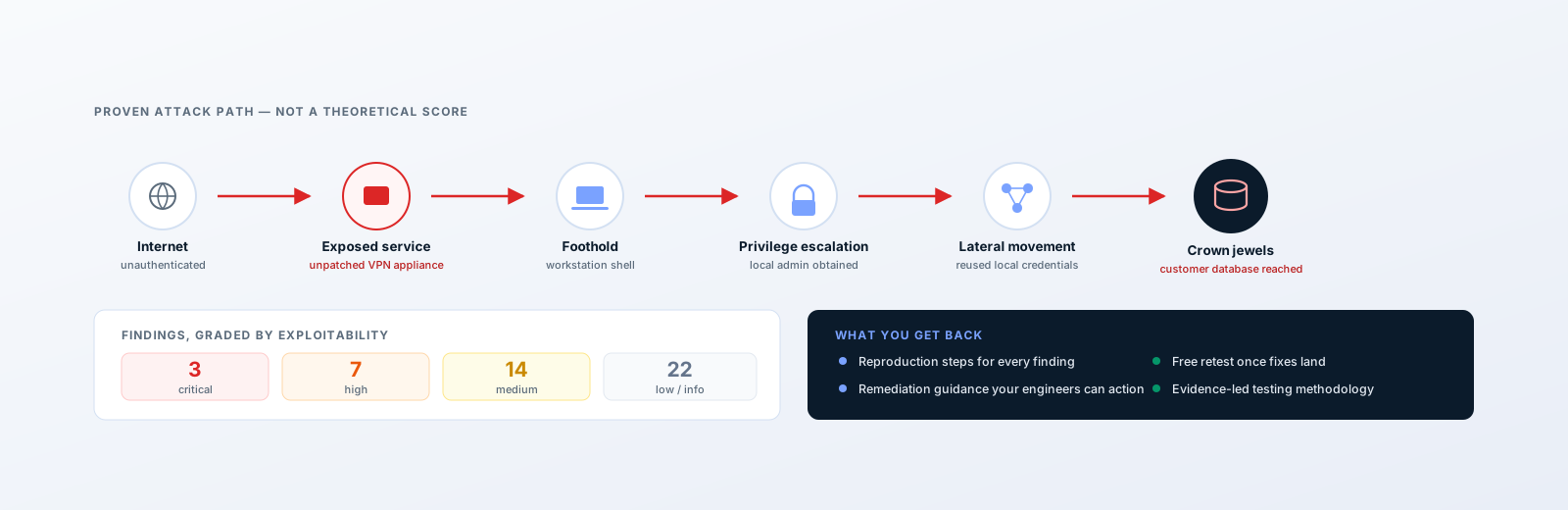
Vulnerability Assessment & Penetration Testing pairs two complementary disciplines. Vulnerability assessment systematically scans and catalogues weaknesses across your estate; penetration testing goes further — skilled testers chain those weaknesses the way a real adversary would, demonstrating actual impact: data accessed, privileges gained, systems controlled.
The output is not a scanner dump. An enterprise-grade VAPT engagement produces evidence of exploitability, business-ranked risk, and a remediation path your engineers can actually execute.
The business case
Why enterprises need it
You can't defend what you haven't measured
Unknown internet-facing assets, forgotten test environments and unpatched services are how breaches begin. Regular assessment keeps your real attack surface — not your assumed one — in view.
Compliance and customers demand proof
ISO 27001, SOC 2, PCI DSS, RBI/SEBI guidelines and enterprise procurement all require periodic independent testing. A credible VAPT report is now table stakes for closing enterprise deals.
Severity scores lie without context
A 'critical' CVE on an isolated system may matter less than a 'medium' misconfiguration on your identity provider. Exploitation-led testing ranks findings by real business impact, so remediation effort lands where it reduces risk most.
How we deliver
Cloud Armor's approach
Scoping & rules of engagement
We define the target estate — external, internal, web applications, APIs, cloud configuration, wireless, social engineering — with clear rules of engagement, testing windows and safe-handling of production systems.
Methodology-driven testing
Testing aligned to OWASP (WSTG/ASVS, API Top 10), PTES and NIST SP 800-115, executed by experienced testers — automated breadth, manual depth, and exploitation with evidence captured at every step.
Reporting for two audiences
An executive summary that speaks business risk for leadership and auditors, and a technical annex with reproduction steps, evidence and specific remediation guidance for engineers — no filler findings.
Remediation support & retest
We stay engaged through the fix: prioritised remediation workshops, direct support to your engineering teams, and a formal retest that verifies closure — so the report ends in reduced risk, not a shelf document.
Methodology
VAPT methodologies
There is no single "penetration test". What you get depends on how much we are told before we start and how much of the work is done by a human. We agree both in the scoping document, in writing, so you know exactly what was and was not covered when the report lands.
How the testing is performed
Manual testing
A human working through the application the way an attacker would — chaining flaws, abusing business logic, and finding the authorisation gaps that only make sense once you understand what the application is for. This is where the findings that matter come from, and it is the majority of every engagement we run.
Automated testing
Tooling runs first and runs broad: known CVEs, outdated components, default credentials, TLS and configuration weaknesses across the whole scope. It gives coverage a human cannot match on volume — but every result is verified by an engineer before it reaches your report, because an unvalidated scanner finding is noise, not a vulnerability.
How much we are told beforehand
Black box
We start with nothing but the target — no credentials, no source, no architecture diagram. It models an external attacker with no inside knowledge and tests what is genuinely reachable from the internet. Realistic, but it can miss depth simply because time runs out before a tester finds the door.
White box
Full disclosure: source code, architecture, privileged credentials and design documents. Nothing is hidden, so coverage is the deepest available and the report can point at the exact line of code. This is the right choice when the goal is to find everything rather than to simulate an outsider.
Grey box
The middle ground, and what most engagements actually use. We get standard user credentials and a basic understanding of the architecture, then test as an attacker who has already gained a foothold or as a malicious insider. It buys most of the depth of white box without spending the engagement mapping what you could simply have told us.
What the testing follows
Recognised methodology, not a personal checklist
Web and API testing follows the OWASP Testing Guide and the OWASP Top 10 and API Top 10; infrastructure work follows the Penetration Testing Execution Standard and NIST SP 800-115. Findings carry CWE classification so they can be grouped and tracked against any framework you already report on.
Evidence for every finding
Each finding is reproducible: the request, the response, the steps and the proof of impact. If we cannot demonstrate it, it does not go in the report as a vulnerability — it goes in as an observation, clearly marked as such.
Client feedback
What clients say after the retest
Related practice areas
VAPT is a service capability rather than a product resale — testing uses a mixed toolchain (commercial and open-source) selected per engagement.
Scope a VAPT engagement
A 30-minute conversation with our engineers is usually enough to map your requirement to a concrete plan and honest estimate.